
Learnings from Manifest: How automation is solving real labor challenges
Robotics & Tech Working in Unison

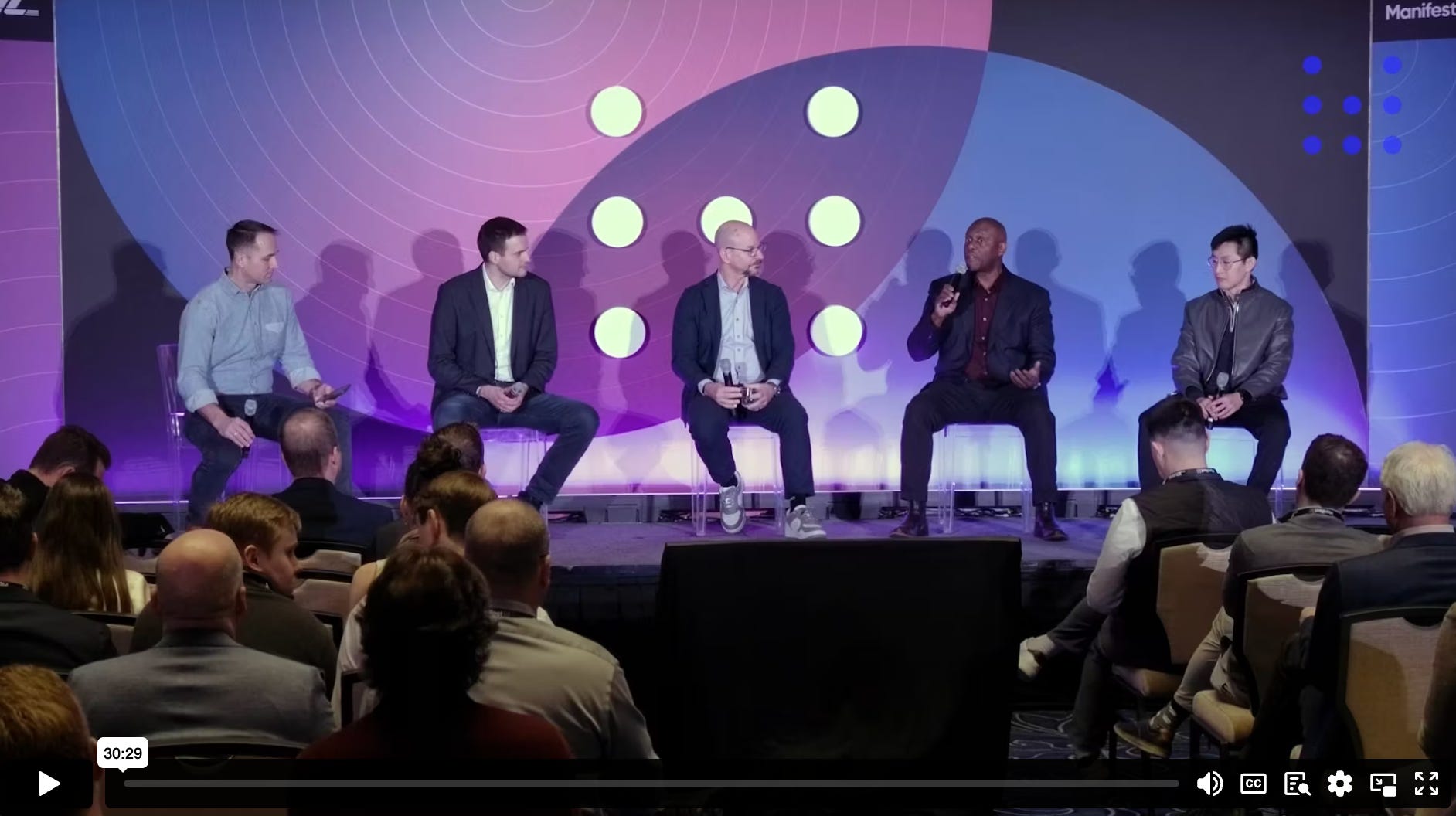
I moderated a panel at Manifest: The Future of Supply Chain & Logistics last week, and the conversation had so many applications to the future of robotics and automation that I had to share with you all.
I don't love Vegas, but I do love talking about robots, automation, deep tech, and how it is imperative that we automate if we are to accelerate human flourishing 🤖 📈
I decided to feed video of our session through AI and it was able to capture some of the top takeaways below. If you only have a few seconds, scroll to the bottom. But if you have time to watch video is below too, it was a really great panel with a handful of new and old friends: Anthony Jules of Robust.AI, Jackie Wu of Corvus Robotics, Jim Hoefflin of Softeon and Josip Cesic of Gideon!
We were talking "Robotics & Tech Working in Unison". Really - we were talking about how this stuff will actually happen, scale, what's in the way, and more.
Officially: "Discover how automation is solving labor challenges, boosting warehouse efficiency, and redefining accuracy and visibility in logistics."
Unofficially? Real talk with real people doing real stuff in the real world. That enough reals for you? Great mix of integrators / startups / scaleups ... and I'll pretend to know a few things as an investor in the space 😂
As moderator, I’ll leave you with the final words from our session:
“Just do it.”

Don’t pilot—purchase, deploy, and scale.

The tech works now.

Thank you all!
~Abe, AlleyCorp / Deep Tech
Panel Photos


Panel Video
Panel Transcript
Moderator:
Welcome, everyone! You all passed the IQ test to be here today. I’m not sure if the sign outside is working, but figuring out that this was Track Three required a process of elimination—so well done! There's a lot happening at the show today, and you chose to be here. That’s pretty cool.
My goal with any panel I moderate is to make it the best one at the show. And with the incredible folks on this stage, we’re going to do just that.
It’s early, but we’ll bring the energy. Honestly, 29 minutes and 22 seconds isn't enough. We need more time because these panelists are sharp. We had a 45-minute prep call, and they schooled me. You're going to learn a lot from them today.
This panel covers:
Inventory drones
Warehouse management systems (WMS)
System integrations
Autonomous mobile robots (AMRs)
Trailer unloading
Warehouse robotics & AI
If you care about logistics and automation, you're in the right place.
Panelist Introductions
Abe Murray (Moderator):
I’m Abe Murray, a General Partner at AlleyCorp, a $250M+ pre-seed and seed fund investing in deep tech, robotics, automation, and energy transition. I have an engineering background and more degrees than I care to list, but we’re here to learn from these panelists.
Let’s introduce them:
Josip Cisik, CEO of Gideon
"Doctor of Robots & Autonomy" with 23 publications (he asked me to mention that—you’ll see why).
Former basketball champ—could have been a top Eastern European player in another life.
Gideon focuses on autonomous forklifts and trailer unloading.
Jim Hoefflin, CEO of Softeon
Logistics industry veteran, leading warehouse management & system integration.
Lived in Holland, plays pickleball at a championship level (seriously, another athlete on stage).
Could school all of us on warehouse operations.
Anthony Jules, CEO of Robust.AI
Former Google engineer, MIT alum, squash player (could probably beat me).
Building collaborative autonomous mobile robots for human-robot teamwork.
Jackie Wu, CEO of Corvus Robotics
Founder of inventory drone company.
Y Combinator alum and table tennis champ.
Booth #801—go see his flying robots in action!
Each of these companies has an impressive presence on the show floor. Make sure to check them out.
Discussion: The State of Robotics in Logistics
Moderator:
We’re at a logistics conference, but let’s acknowledge a reality—most warehouses are still manual. The majority of supply chain operations aren’t automated. We all know this, but we’re here to discuss:
Why is that?
What’s blocking automation?
How do we fix it?
Jim (Softeon, WMS & Integration Expert):
The main challenge is variation.
Some warehouses are still on first-gen WMS.
Others have been through multiple rounds of automation.
If you try to automate everything, you fail.
The key is targeted automation—focusing on the right areas first.
Anthony (Robust.AI, Collaborative Robots):
Integration is hard in two ways:
Technical integration—Robots must work with WMS, real-time data, and humans.
Change management—People need to understand what’s changing and adapt quickly.
If you segment automation into smaller projects, you get faster adoption.
Josip (Gideon, Autonomous Forklifts):
Technology wasn’t ready—robots couldn't handle unstructured environments like trailer loading/unloading.
Today, with AI & better sensors, robots can make real-time decisions.
Change management is the last hurdle—companies must embrace adoption.
Jackie (Corvus Robotics, Inventory Drones):
Traditional inventory tracking is awful—manual barcode scanning, lost pallets, expensive cycle counts.
Our drones fly themselves—no stickers, no human pilots.
Deployment takes days, not months.
Challenges in Adopting Robotics
Moderator:
Each of you is building real-world automation. What’s blocking wider adoption?
Josip (Autonomous Forklifts):
Forklift labor shortage—1M forklift drivers in the U.S., 340K on trailer loading alone.
High turnover—50-100% annually.
ROI is clear, but adoption is slower than it should be.
Jim (WMS & Integration):
Market inertia—Companies stick with legacy WMS (Manhattan, Blue Yonder, etc.).
Pulling out old systems is hard—we have to fight momentum.
New automation is disrupting the norm, but many companies fear change.
Anthony (Collaborative Robots):
Robots must work with people—not just “coexist,” but actively collaborate.
Example: If a cherry picker needs to get through, just grab the robot and move it—no laptop, no engineer.
Getting people to trust and adopt new tech is the hardest part.
Jackie (Inventory Drones):
Safety concerns—People think drones are risky, but ours are lightweight, collision-avoidant, and safer than forklifts.
Cost perception—Drones used to be expensive, but hardware costs have dropped significantly.
ROI & The Business Case for Automation
Moderator:
Companies need hard ROI. But sometimes, automation isn’t about cost savings—it’s about labor shortages and operational resilience.
How do you convince customers?
Josip (Forklifts):
50%+ labor turnover = instability.
Robots reduce cost & safety risks.
Adoption is slow, but once a company sees results, they expand fast.
Jim (WMS):
ROI is important, but today’s discussions are more about capacity and reliability.
Many businesses can’t find workers—robots fill the gap.
Anthony (Collaborative Robots):
ROI on day one is our metric.
We simulate a year’s worth of data for each customer before selling.
If the ROI isn’t clear, we don’t waste their time.
Jackie (Drones):
Physical inventory is a mess.
Companies waste time & money manually tracking it.
Our drones cut that cost drastically.
Closing Thoughts: The Future of Robotics in Warehouses
Moderator:
We’re out of time. One final thought from each of you?
Jackie:
Flying robots. Booth #801. Come see them.
This feels like my life’s work—supply chain + automation is the future.
Anthony:
Truly collaborative robots—people and machines working together, not separately.
Reducing 30,000 steps per worker per day is a big deal.
Jim:
Integrating automation and humans is key.
The next wave is making automation seamless.
Josip:
Truck unloading is hard—but AI finally makes it possible.
We’re at an inflection point—time to scale up.
Final words: Just Do It!
Moderator (Final Words):
“Just do it.”
Don’t pilot—purchase, deploy, and scale.
The tech works now.
Thank you all!